- science
A Huge Possible Dwarf Planet Emerges in Rubin Observatory Data
2026 ED138 may span 600 to 1,500 kilometres, making it a strong dwarf-planet candidate. Astronomers announced it October 27 after software linked its motion in data from Chile’s Vera C. Rubin Observatory, a telescope. It could join five recognized dwarf planets, but remains unconfirmed; infrared follow-up will refine its size and test whether it qualifies.
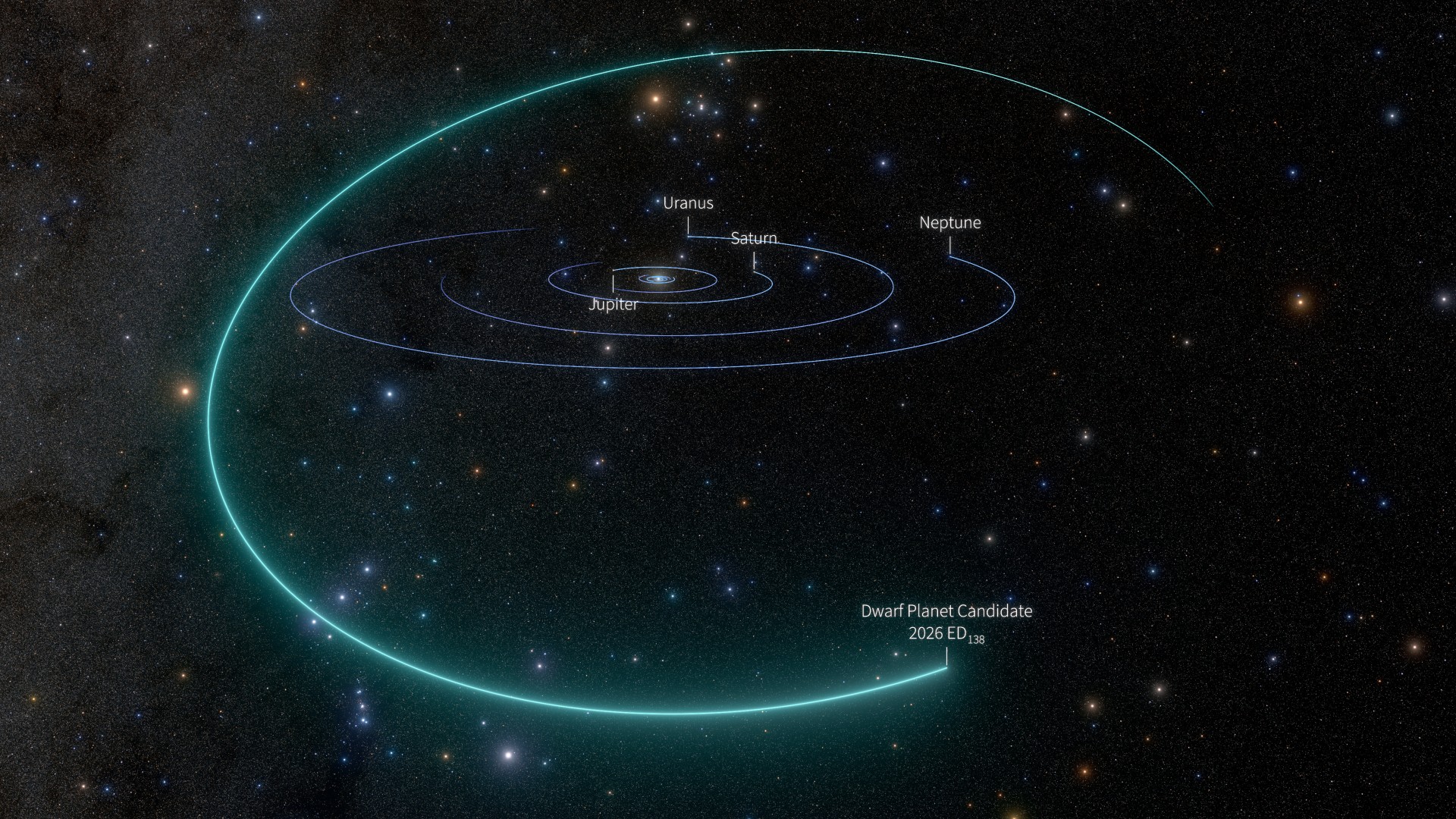
On October 13, astronomer Matthew Holman found an unusually bright moving object hidden in data from Chile’s Vera C. Rubin Observatory. The object, now called 2026 ED138, may be 600 to 1,500 kilometres across, making it a strong dwarf planet candidate. Astronomers announced the discovery on October 27 but have not confirmed its status. 12
Holman made the discovery while searching Rubin observations with software he built with colleague Kevin Napier. Holman is an astrophysicist at the Harvard & Smithsonian Center for Astrophysics. The program links points of light recorded on different nights to find moving objects. University of Washington astronomer Mario Jurić found more evidence in the observatory’s records: Rubin had captured ED138 30 times over 20 nights between March 4 and July 11, 2026. Older images showed it as far back as 2016. 46
Those older images help explain why a potentially large world went unnoticed. ED138 lies near the Milky Way’s crowded band of stars, where its slow movement is hard to spot. It is about 46 times farther from the Sun than Earth, and its orbit tilts nearly 25 degrees from the solar system’s main plane. The size estimate depends on how much sunlight its surface reflects, so it could be smaller and brighter or larger and darker.2413 If its gravity has made it round, it could join Pluto, Ceres, Eris, Haumea and Makemake, the five dwarf planets recognized by the International Astronomical Union. 8
This possible sixth member also shows what Rubin’s repeated sky scans can do: find a faint moving object, then search old records to trace its path. Rubin’s 10-year survey is expected to find more objects in the outer solar system. For ED138, the next step is infrared follow-up, which should help scientists work out its size and decide whether it is round enough to qualify as a dwarf planet. 18
Questions about this story
Why did astronomers miss ED138 for years?▾
What makes an object a dwarf planet?▾
It must orbit the Sun and have enough gravity to become roughly round, while not clearing other objects from its orbital neighbourhood. 8
Sources (14)
- 1
Astronomers found a mysterious object beyond Neptune, and it could be a new dwarf planetspace.com
- 2
2026 ED138: Rubin Observatory Finds Possible Dwarf Planet Beyond Neptune [In Pics]in.mashable.com
- 3
Once-in-a-Generation Find: a Friend for Plutonewser.com
- 4
Astronomers Have Found a Possible New Dwarf Planet Beyond Pluto. It's the Sixth in the Solar System and It Was Hiding in Plain Sightzmescience.com
- 5
Rubin Observatory finds possible dwarf planet beyond Pluto | Tap to know more | Inshortsinshorts.com
- 6
Rubin Observatory discovers dwarf planet candidate 2026 ED138 — ScienceAlertua.news
- 7
Astronomers Discover a Giant New Dwarf Planet Candidate Hiding Beyond Plutosciencealert.com
- 8
Did astronomers just find a new planet in our Solar System? Yes and noindiatoday.in
- 9
Rubin Observatory finds new dwarf planet candidate in our solar systemthebrighterside.news
- 10
A new pal for Pluto? Rubin Observatory finds its first dwarf planet candidategeekwire.com
Show all 14 sources
- 11
The Vera C. Rubin Observatory may have just discovered our solar system’s sixth dwarf planetscientificamerican.com
- 12
2026 ED138 orbit in 3Dnoirlab.edu
- 13
Potential new dwarf planet found by Harvard astrophysicistswgbh.org
- 14
New dwarf planet candidate discovered by NSF–DOE Rubin Observatory | NSF - U.S. National Science Foundationnsf.gov
1 minute read.